
A research team led by Researcher Fang Keyan at Fujian Normal University (FNU) has made significant progress in predicting the El Niño–Southern Oscillation (ENSO). Their findings were published in the Proceedings of the National Academy of Sciences of the United States of America (PNAS), a leading international multidisciplinary journal. The paper is titled Identifying key convection sensitive oceanic regions to weaken the ENSO spring predictability barrier.
ENSO is the strongest interannual climate signal arising from ocean–atmosphere interactions over the tropical Pacific and has profound impacts on global climate patterns. However, its predictability drops sharply during the boreal spring—a well-known challenge called the spring predictability barrier. This occurs because weaker ocean–atmosphere coupling during spring limits the sustained development of ENSO signals.
It is widely recognized that changes in sea surface temperature (SST) can significantly influence atmospheric convection and, in turn, affect the Walker Circulation and ENSO evolution. Therefore, identifying oceanic regions most favorable for convection development in spring may offer an effective strategy for reducing the spring predictability barrier. However, traditional ENSO prediction indices—such as Pacific Niño indices—focus primarily on SST anomalies in fixed regions and struggle to capture changes in the spatial extent of key oceanic areas.
To address this limitation, the study introduces a new metric: the SST Range Index (SRI). The SRI characterizes variations in the spatial extent of tropical oceanic regions where convection is sensitive to SST changes during spring. The results show that in spring, two specific areas are critical for triggering persistent, strong convection: the central-eastern Pacific, where SST exceeds 26°C, and the eastern Atlantic, where SST exceeds 28.5°C. The expansion of these convection-sensitive regions enhances the Bjerknes feedback by modulating the Walker Circulation, thereby providing effective predictive signals for ENSO evolution.
Building on this finding, the research team developed a deep learning model for ENSO prediction that incorporates both the SRI and conventional ENSO predictors as input variables. The results indicate that this deep learning model outperforms the average performance of both dynamical and statistical models, with particularly strong predictive skill for multi-year La Niña events. This study offers a new pathway for mitigating the spring predictability barrier.
Lead Institution and Authors
FNU is the lead institution for this study. Mei Zepeng, a doctoral student at the School of Geographical Sciences and the School of Carbon Neutrality Future Technology, and Lin Shuheng, a postdoctoral researcher, are co-first authors. Researcher Fang Keyan is the corresponding author. Other co-authors include Zhou Feifei, Tang Wanru, Wu Hao, Zhao Zheng, and Xie Xiaoxun from FNU; Professor Liu Fei from Sun Yat-sen University; Researcher Zhao Sen from the University of Hawaii; Associate Professor Li Jinbao from the University of Hong Kong; Senior Engineer Ou Tinghai from the University of Gothenburg; and Academician Chen Deliang from Tsinghua University.
Funding
The study was supported by the National Natural Science Foundation of China (NSFC) (grants 41988101, 42505021, 42301058), the NSFC Excellent Young Scientist Fund (42425101), the China Postdoctoral Science Foundation (GZC20250218), and the Fujian Institute for Cross-Strait Integrated Development (LARH24JBO7), among other funding sources.
Figures
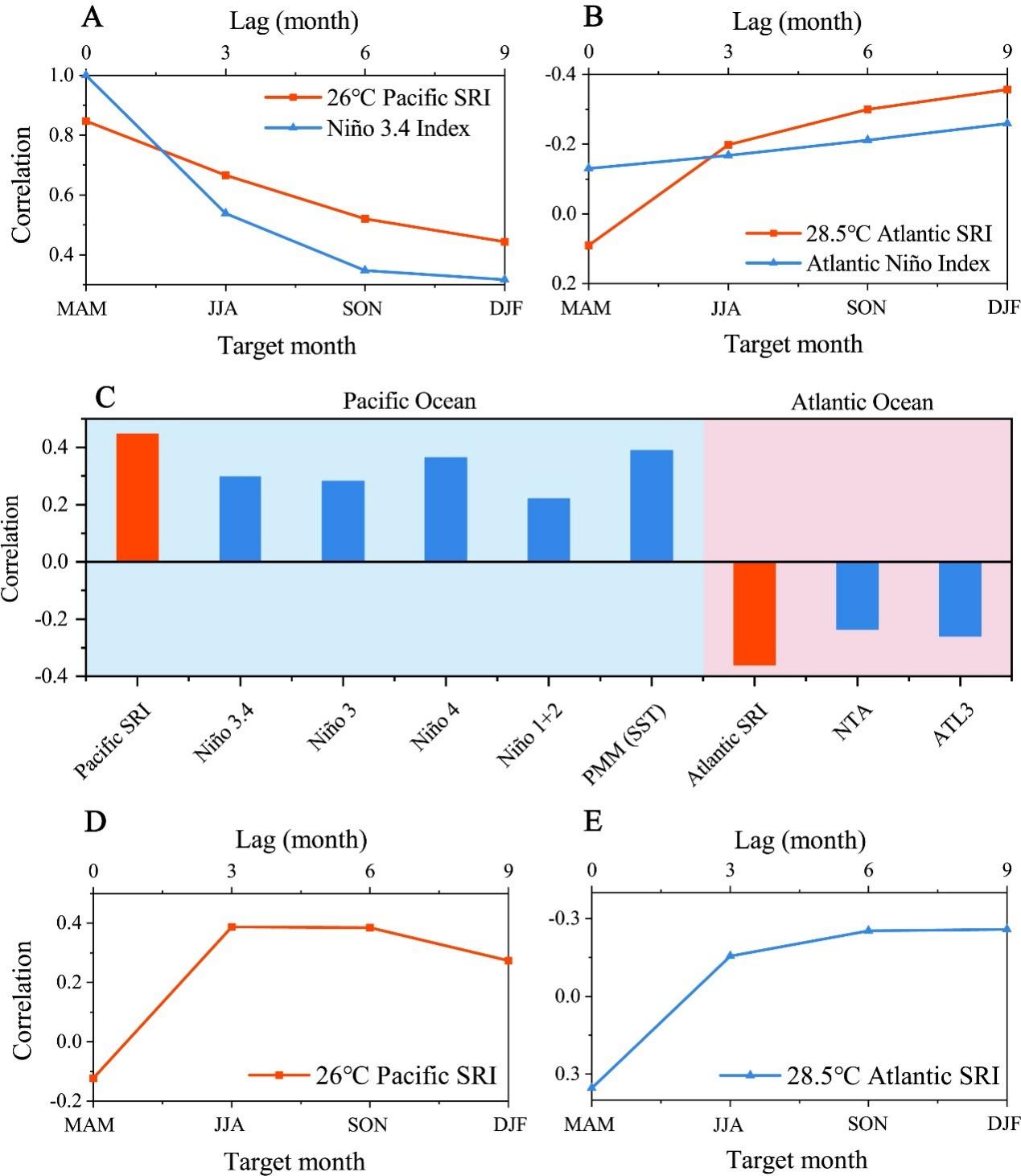
Figure 1 compares the predictive skills of the spring SRI with those of traditional ENSO predictors.
(A) Correlation between spring Pacific 26°C SRI and subsequent seasonal Niño 3.4 index.
(B) Correlation between spring Atlantic 28.5°C SRI, Atlantic Niño index, and subsequent seasonal Niño 3.4 index.
*(C) Correlation between all spring SST anomaly-based ENSO predictors and winter Niño 3.4 index.*
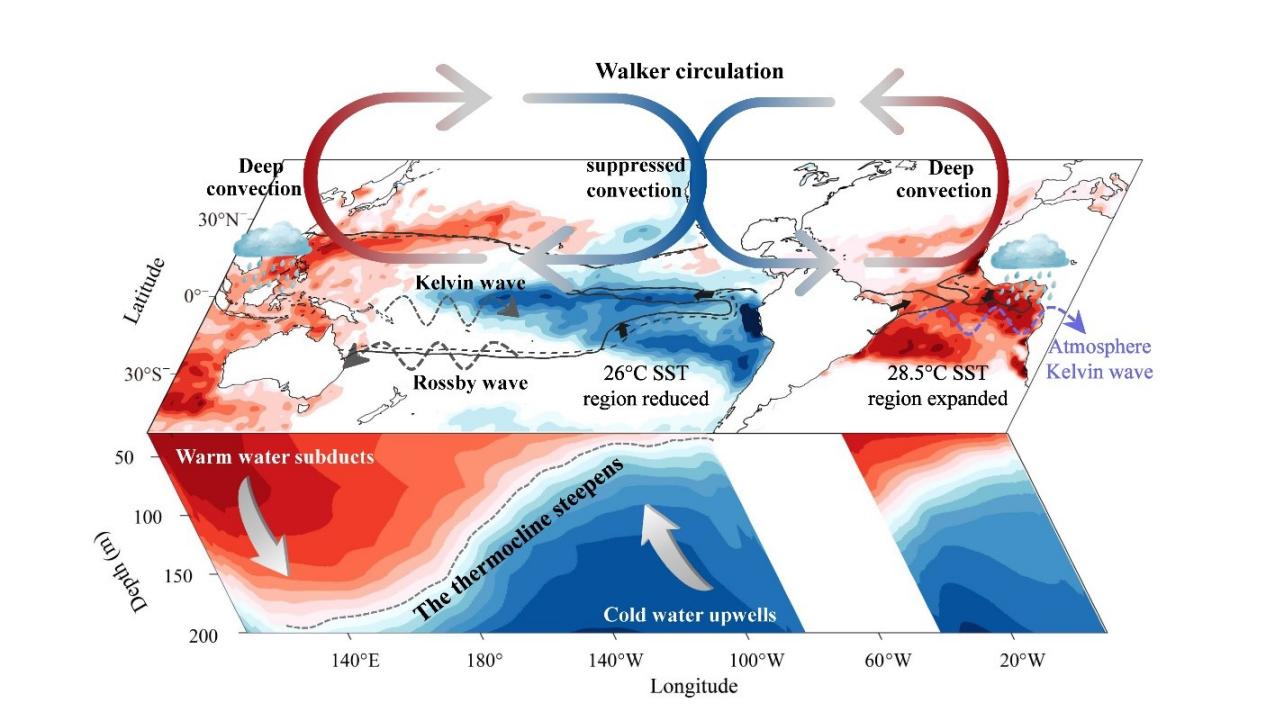
Figure 2 provides a schematic diagram of the mechanism by which changes in the extent of convection-sensitive oceanic regions in the spring Pacific and Atlantic affect convection and promote the development of La Niña events.
Ascending convection in the western Pacific and Atlantic, combined with descending convection in the eastern Pacific, forms a trans-Pacific and trans-Atlantic Walker Circulation. This process significantly strengthens equatorial easterlies, drives warm water westward, and steepens the equatorial thermocline slope, collectively promoting the development of La Niña events through the combined effects of the Pacific and Atlantic.