
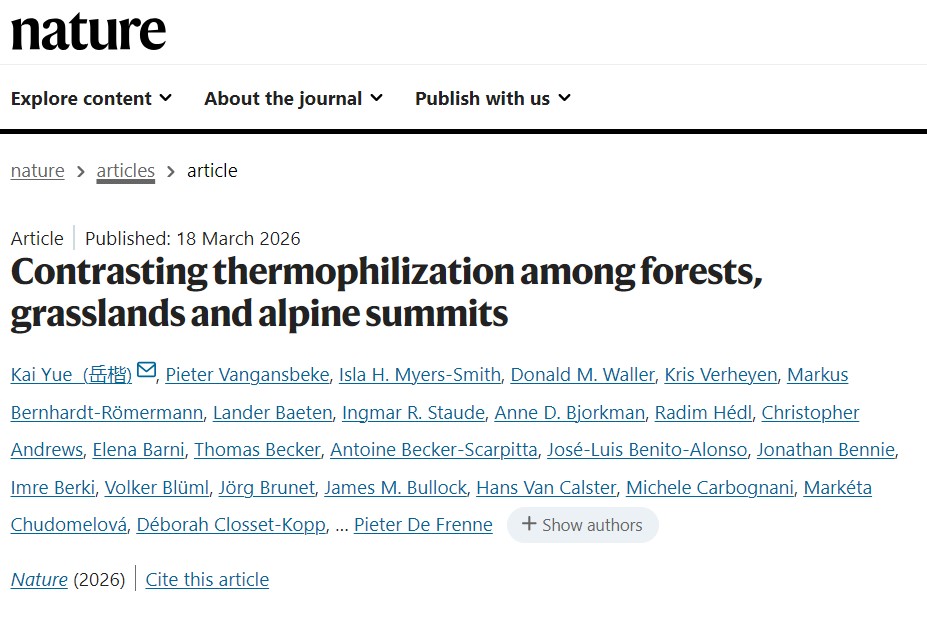
On March 18, Researcher Yue Kai from the School of Geographical Sciences and the School of Carbon Neutrality Future Technology at Fujian Normal University published a paper titled Contrasting thermophilization among forests, grasslands and alpine summits in Nature, one of the world's leading academic journals.
Fujian Normal University is the primary affiliated institution. Researcher Yue Kai serves as both the first author and corresponding author, with Professor Wu Fuzhong, Professor Pieter De Frenne, and others as co-authors.
Research Background
Against the backdrop of global climate warming, the composition of biological communities is undergoing continuous change. A growing body of research suggests that rising temperatures may favor warm-adapted species, while cold-adapted species face an increasing risk of decline or even extinction. However, whether vegetation communities across different ecosystems respond consistently to climate change—and the extent to which such changes have already occurred—has lacked systematic evaluation based on large-scale, long-term data.
Methodology
To address this gap, Researcher Yue Kai and Professor Wu Fuzhong from Fujian Normal University, together with Professor Pieter De Frenne from Ghent University in Belgium and scholars from 76 universities and research institutions across Europe, Canada, and the United States, compiled long-term resurvey data spanning 12 to 78 years from 6,067 vegetation plots across three typical ecosystems: forests, grasslands, and alpine regions. They systematically analyzed the patterns and mechanisms of plant community thermophilization (the shift toward warm-adapted species) and climatic debt (the lag between community change and temperature increase) under climate warming, as well as differences across ecosystems.
Key Findings
Thermophilization rates in forest understory and grassland vegetation are relatively low, at approximately 0.03°C per decade, and are not statistically significant. In contrast, alpine vegetation exhibits a much higher and statistically significant thermophilization rate of about 0.12°C per decade—far exceeding those observed in forests and grasslands.
Underlying mechanisms differ markedly among ecosystem types. In grasslands, thermophilization is primarily driven by increases in the abundance or richness of warm-adapted species. In alpine ecosystems, it is mainly driven by declines in cold-adapted species. In forest understory vegetation, thermophilization is jointly regulated by both the increase in warm-adapted species and the decrease in cold-adapted species.
Climatic debt is evident across all ecosystem types, ranging from 0.13°C to 0.34°C per decade, indicating that plant community change lags substantially behind the pace of climate warming. Climatic debt is greatest in forests—primarily due to the buffering effect of the forest canopy—followed by alpine ecosystems, and smallest in grasslands.
The relationship between thermophilization rates and the rate of temperature increase is relatively weak, whereas climatic debt shows a stronger correlation with the rate of temperature change.
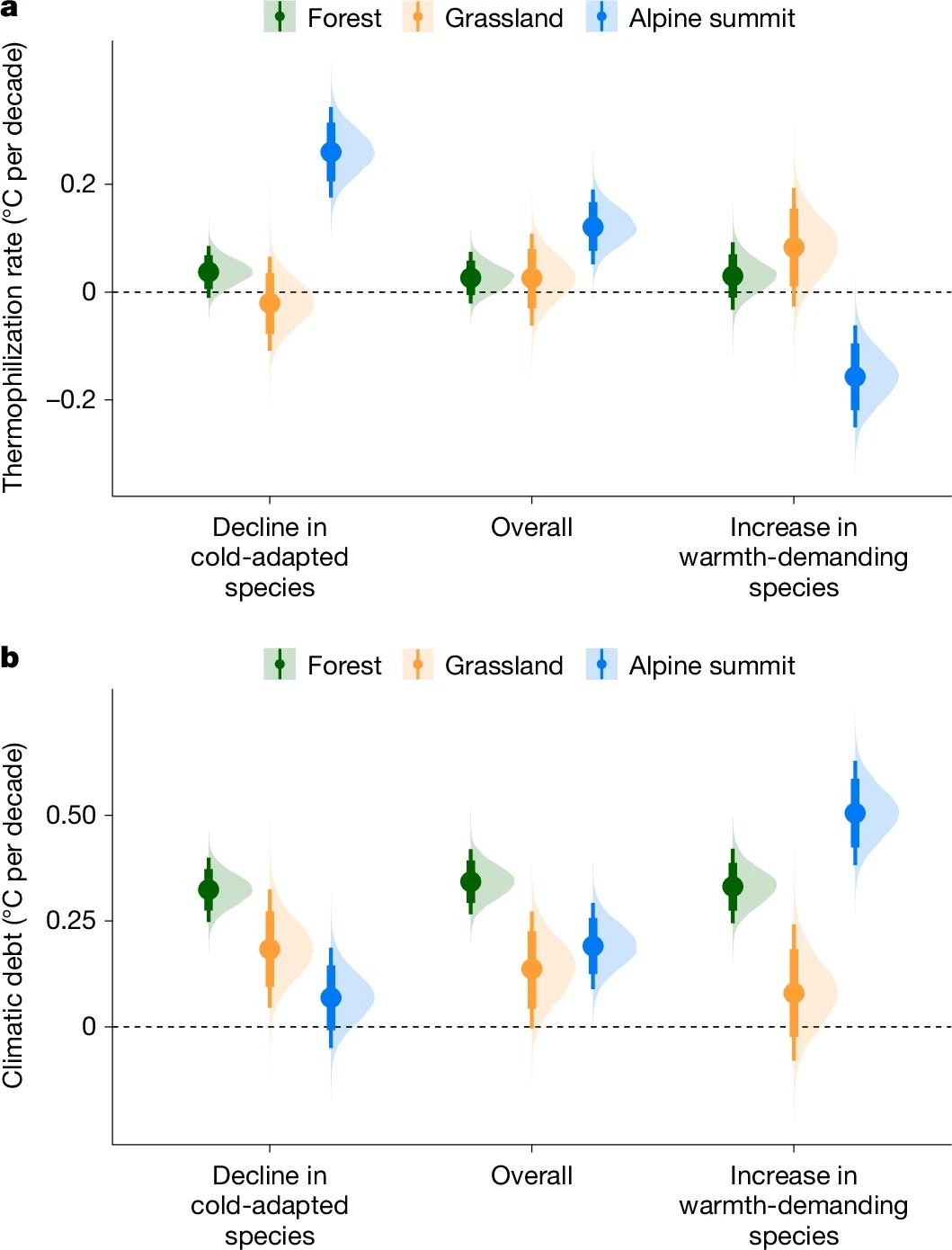
Figure 1 Thermophilization and Climatic Debt Characteristics of Vegetation across Different Ecosystems
Significance
These findings deepen our understanding of how climate warming affects vegetation communities across different ecosystem types. They also provide important evidence for assessing the potential impacts of climate change on ecosystem stability and biodiversity. The study contributes to improving societal awareness of the ecological consequences of climate change and offers scientific support for future biodiversity conservation and ecosystem management decisions.
Funding
This research was supported by the National Natural Science Foundation of China (32271633, 32011530426), the National Key R&D Program for Young Scientists Project (2023YFF1305500), an ERC Starting Grant and ERC Consolidator Grant, and the Alexander von Humboldt Foundation (Humboldt Research Fellowship).
Original Article Link
https://www.nature.com/articles/s41586-025-09622-7
Translated by Yao Shaoli
Reviewed by Lin Bin