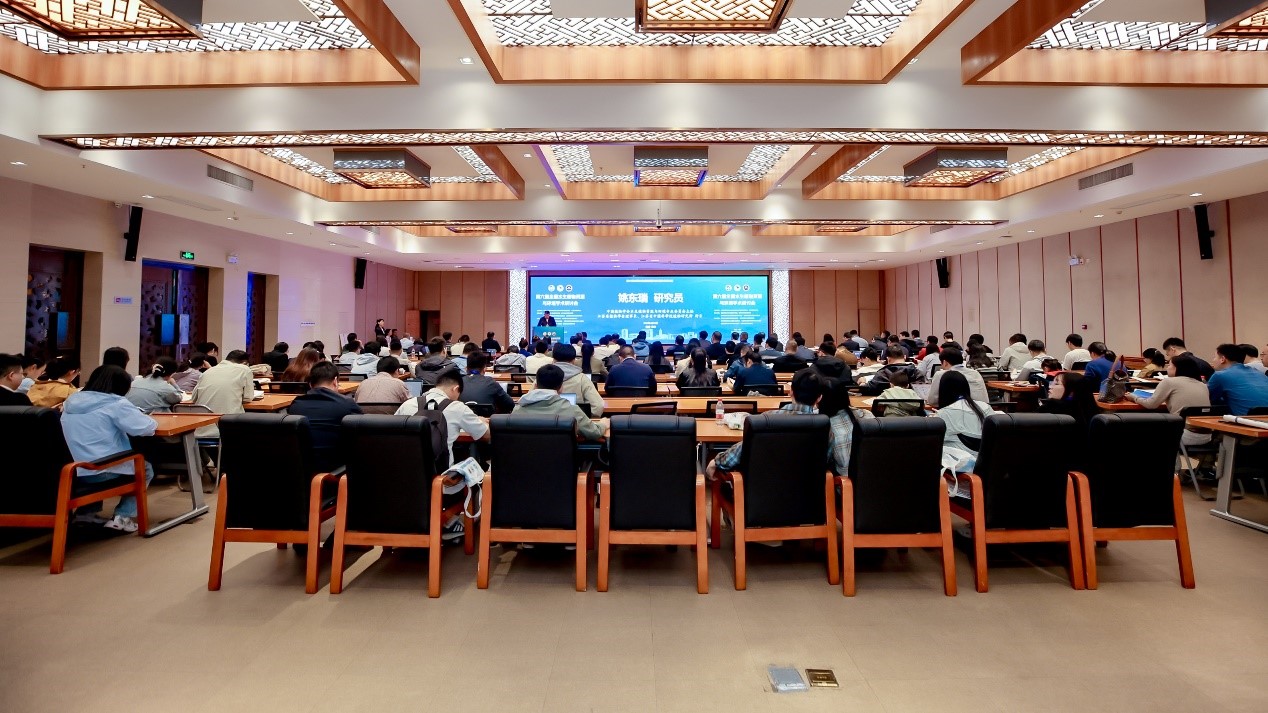
Fuzhou, April 26 – The 6th National Symposium on Aquatic Plant Resources and Environment was successfully held in Fuzhou, Fujian Province, from April 24 to 26. The event was co-organized by the Professional Committee of Aquatic Plant Resources and Environment under the Botanical Society of China and the Jiangsu Botanical Society. It was hosted by the College of Geographical Sciences, the College of Carbon Neutrality Future Technology, the Fujian Key Laboratory of Subtropical Resources and Environment, and the Fujian Key Laboratory of Plant Physiology and Ecology at Fujian Normal University (FJNU).
The symposium brought together more than 180 experts, scholars and representatives from universities and research institutions nationwide. Distinguished attendees included: Yao Dongrui, Director of the Professional Committee of Aquatic Plant Resources and Environment, Chairman of the Jiangsu Botanical Society and Director of the Institute of Botany, Jiangsu Province & Chinese Academy of Sciences; Wang Zongming, Party Secretary of the Northeast Institute of Geography and Agroecology, Chinese Academy of Sciences; Chen Xiaobin, Vice President of FJNU; Zeng Hong, Deputy Director of the Professional Committee and Secretary-General of the Jiangsu Botanical Society; as well as senior administrators from FJNU’s College of Geographical Sciences and College of Carbon Neutrality Future Technology. Opening remarks were delivered by Vice President Chen Xiaobin and Director Yao Dongrui.
In his address, Chen Xiaobin briefed participants on FJNU’s institutional profile and recent research achievements. He emphasized that aquatic plants serve as a critical barometer of aquatic ecosystem health and play an indispensable role in protecting rivers, lakes and reservoirs. The symposium focused on cutting-edge themes including aquatic plant biodiversity and physio-ecological processes, ecological adaptation and climate change responses, and the development of aquatic plant resources and ecological restoration technologies. The event actively aligns with the national 15th Five-Year Plan’s goals of advancing the comprehensive green transition of economic and social development and building a Beautiful China.
Yao Dongrui noted that systematic research on aquatic plant resource conservation, functional characterization and ecological application is essential to advancing Xi Jinping Thought on Ecological Civilization. It also provides a scientific foundation for safeguarding national aquatic ecological security, supporting the dual carbon goals and the Beautiful China initiative, and fostering green development. He added that the symposium deepened the integration of basic research and applied technologies in aquatic plant sciences, offering robust scientific and technological support for national wetland protection and aquatic ecosystem restoration.
The symposium featured two keynote presentations by leading scholars: Wang Zongming delivered a lecture on “Remote Sensing Classification of Coastal Mangrove Communities in China”, while Yao Dongrui spoke on “Invasion Mechanisms, Resource Utilization and Intelligent Early Warning of Typical Invasive Aquatic Plants”. Distinguished experts also gave plenary reports covering key research areas:
Researcher Cui Yibin, Nanjing Institute of Environmental Sciences, Ministry of Ecology and Environment: Phosphorus Source-Sink Dynamics in Poyang Lake and Restoration of Degraded Aquatic Ecosystems
Professor He Qiang, Fudan University: Key Trophic Level Processes in Coastal Wetland Vegetation Restoration
Researcher Li Wei, Wuhan Botanical Garden, Chinese Academy of Sciences: Adaptability and Ecological Impacts of Carbon Acquisition Strategies in Aquatic Plants
Researcher Chang Yajun, Institute of Botany, Jiangsu Province & Chinese Academy of Sciences: Carbon-Nitrogen Synergy in Submerged Plants with Distinct Carbon Metabolic Pathways Under Elevated CO₂ and Ammonium Stress
Researcher Sun Zhigao, FJNU: Biogeochemical Cycling and Environmental Effects of Wetland Ecosystems in the Min River’s Fuzhou Section
In addition, the symposium hosted five parallel sessions featuring 84 academic presentations. A total of 21 papers were recognized as Outstanding Conference Papers.