
A research team led by Professor Li Li at Fujian Normal University has recently achieved a significant breakthrough in natural product biosynthesis and synthetic biology. Their work was published in the prestigious international journal Nature Communications under the title "Toward sustainable food preservatives: high-level production of sorbic acid in engineered Saccharomyces cerevisiae." This study reports the bioproduction of sorbic acid (SA) through microbial fermentation by decoding its biosynthetic pathway and engineering Saccharomyces cerevisiae as a production chassis, offering new routes for the sustainable manufacturing of food preservatives.
Sorbic acid and its salts are among the most widely used and safest food preservatives globally, extensively applied in food, beverages, and personal care products, supporting an industry worth hundreds of billions of dollars. However, their industrial production still relies on fossil fuel–derived feedstocks via chemical synthesis—a process that not only consumes non-renewable resources and imposes severe environmental burdens but also falls short of the growing consumer demand for natural ingredients and clean-label products. Therefore, developing green and sustainable biomanufacturing technologies for sorbic acid holds both significant scientific value and industrial promise.
To address this critical challenge, the team identified SA and its amide derivative, sorbamide (SN), from Myrothecium sp. FJNU6—marking the first discovery of SA from a microbial source and challenging the conventional view that these compounds are exclusively plant-derived. Through genome sequencing and functional validation, they successfully decoded the microbial biosynthetic pathway, identifying a key gene cluster comprising a highly reducing polyketide synthase (SoaA), a hydrolase (SoaB), and an amidotransferase (SoaC). By reconstituting and optimizing the SoaA–SoaB pathway in S. cerevisiae through multilevel engineering, they elucidated the biosynthetic mechanism at the molecular level.
Building on this foundation, the team adopted S. cerevisiae—a Generally Recognized as Safe (GRAS) organism—as the production chassis, and performed systematic metabolic engineering and fermentation process optimization. To address growth inhibition caused by the toxicity of sorbic acid to host cells, the team developed a dynamic expression regulation system to decouple growth from production phases. They enhanced the supply of acetyl-CoA and malonyl-CoA, optimized carbon flux distribution to improve precursor availability, and targeted the biosynthetic pathway to peroxisomes to enrich substrates and isolate toxicity—resulting in an approximately 15-fold increase in production titer. For scale-up, a two-stage fed-batch process with coordinated carbon source and pH control was established, achieving a sorbic acid titer of 1.84 g/L in a 50 L bioreactor. This represents the highest level of sorbic acid biosynthesis reported in S. cerevisiae to date, confirming the feasibility of large-scale production.
This study presents the first complete elucidation of the microbial biosynthetic mechanism of sorbic acid. It establishes an integrated full-chain biomanufacturing technology system that spans pathway discovery, chassis engineering, and process optimization—offering a new paradigm to replace conventional fossil-fuel-dependent routes. The findings lay a core technological foundation for the sustainable and low-carbon manufacturing of food preservatives, while also providing a replicable and generalizable technical framework for the efficient biosynthesis of diverse polyketide natural products. With further optimization of fermentation processes and cost reduction, the biomanufacturing technology for natural sorbic acid holds promising industrial prospects. It is expected to drive the green and low-carbon transformation of the food industry and contribute to the high-quality, sustainable development of the health-related sector.
Fujian Normal University is the lead institution for this study. Xiao Jianbin (2023 doctoral student) and Lin Wei (2022 doctoral student) from the College of Life Sciences are co-first authors. Professor Li Li is the corresponding author. Dr. Zhang Mingliang from Fujian Normal University and Professor Zhou Yongjin from the Dalian Institute of Chemical Physics, Chinese Academy of Sciences, serve as co-corresponding authors. This work was supported by the National Key Research and Development Program of China, the National Natural Science Foundation of China, and other funding sources.
Original Article Link: https://doi.org/10.1038/s41467-026-72163-8
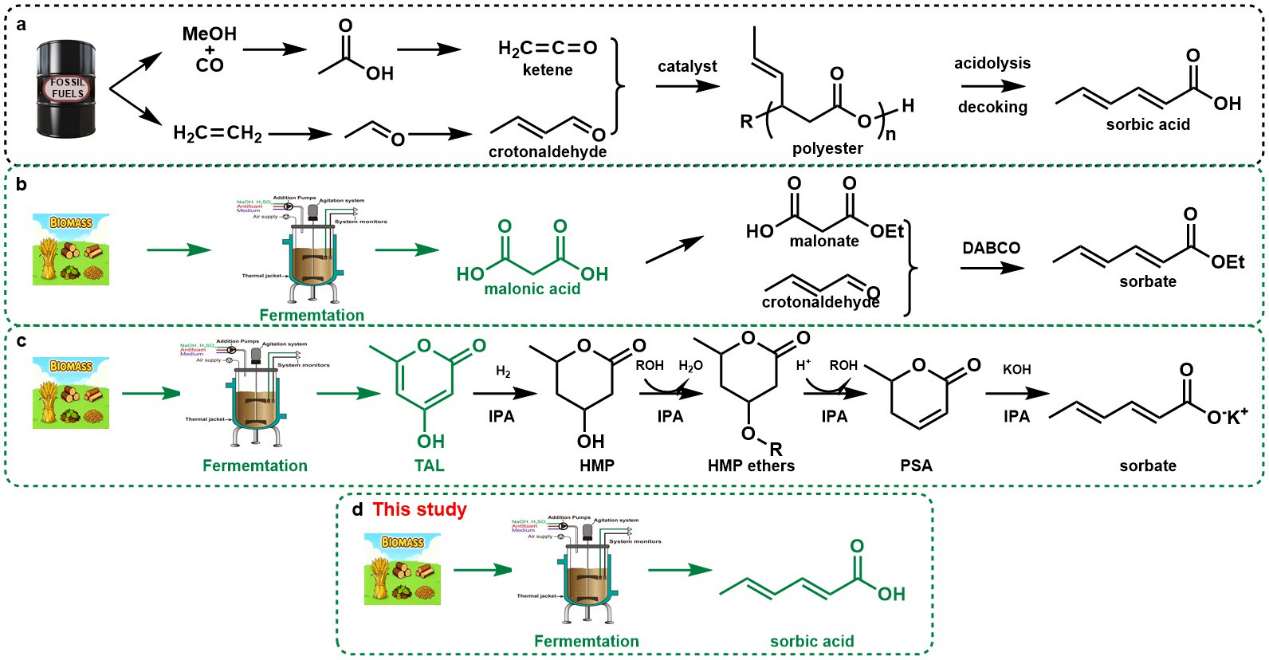
Figure 1 Comparison of synthesis routes to sorbic acid and sorbate.
(A) Conventional industrial route using fossil-derived feedstocks (the predominant approach in current commercial production).
(B) Route employing biobased malonic acid.
(C) Route utilizing biobased triacetic acid lactone (TAL).
(D) One-step fermentation process for sorbic acid production (this study).
Abbreviations: TAL, triacetic acid lactone; DABCO, 1,4-diazabicyclo[2.2.2]octane; IPA, isopropyl alcohol; HMP, 4-hydroxy-6-methyltetrahydro-2-pyrone; PSA, parasorbic acid. Chemical structures were drawn using ChemDraw Professional 17.0. Created in BioRender. Li, L. (2026) https://BioRender.com/fczlsmh
Translated by Lin Jiaxin / Reviewed by Yang Li