
On June 22, the research team led by Professor Ouyang Songying from Fujian Normal University (FNU) published their latest discovery online in Nature Communications under the title "Molecular basis of host ATP level modulation by actin-dependent secreted bacterial ATPase and its metaeffector."
Infectious diseases caused by major pathogenic bacteria impose severe health burdens and economic losses worldwide, posing systemic threats to public health and socioeconomic development. Legionella pneumophila, a typical intracellular bacterial pathogen and the causative agent of Legionnaires' disease, translocates over 330 effector proteins into host cells via the Dot/Icm type IV secretion system. These effectors precisely hijack and regulate various host cellular processes to promote bacterial proliferation and infection. In the evolutionary arms race between pathogens and host cells, ATP—the "energy currency" of the host—inevitably becomes a core target of competition.
Building on Previous Findings
In their 2024 Nature Communications study on the S-HxxxE family of effector proteins—conducted in collaboration with Professor Luo Zhaoqing's team at Purdue University—Professor Ouyang's team reported that LnaB, a key member of this family, utilizes ATP to drive phosphoryl-AMPylation modification, while another member, MavL, exerts ADP-ribosyl hydrolase activity. Together, they convert SidE-derived phosphoribosyl ubiquitin (PR-Ub)—a toxic intermediate generated during infection—into functional ubiquitin and ADP-ribose (ADPR), thereby maintaining host ubiquitin homeostasis. This hijacked state provides a favorable microenvironment for bacterial proliferation at the expense of host health.
In 2025, the team further elucidated the two-step catalytic mechanism of LnaB—ATP hydrolysis followed by coupled AMP transfer—in Nature Chemical Biology. They also discovered that Ceg14, another member of the same protein family, does not catalyze AMPylation. Instead, it hydrolyzes ATP into AMP and pyrophosphate (PPi) in an actin-dependent manner, although the molecular basis underlying this functional divergence remained unclear.
New Insights into Ceg14 Regulation
In their latest Nature Communications paper, the team reveals the molecular mechanism by which Ceg14 precisely regulates host ATP hydrolysis under the coordinated action of host actin and its metaeffector AnkJ. The researchers identified S-HxxxE family proteins widely distributed across more than 20 bacterial taxa and uncovered the regulatory mechanism of Ceg14: host actin activates its ATP hydrolysis activity, while the effector AnkJ exerts allosteric inhibition on this activity.
Through cryo-electron microscopy (Cryo-EM) structural determination and molecular dynamics simulations, the study found that actin binding triggers conformational rearrangement of Ceg14 to activate its enzymatic activity, whereas AnkJ locks the catalytic pocket in an intermediate state, thus allosterically suppressing its ATPase activity. Based on these findings, the team proposed a Type I/Type II functional classification framework for the S-HxxxE protein family, which has been validated in multiple homologous proteins. This work provides a new perspective on the energy competition between pathogens and their hosts and represents another breakthrough by the team in the field of S-HxxxE family effector proteins.
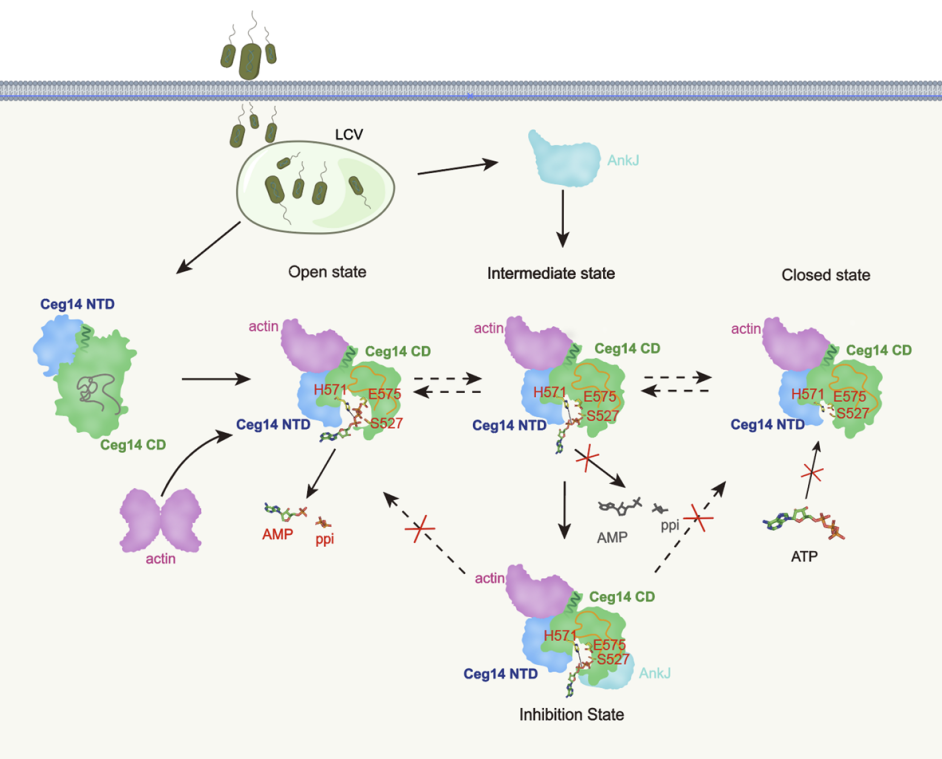
Figure 1 Mechanism of coordinated regulation of host ATP hydrolysis by the Ceg14-actin-AnkJ system.
Authors and Affiliations
FNU is the first affiliation of this study. Co-first authors include Associate Professor Guan Hongxin and PhD candidate Zhang Luhao from the College of Life Sciences at FNU, PhD candidates Li Yu and Jiang Yuchen from Xiamen University, and Xie Song from Fuzhou University. Professor Ouyang Songying (FNU College of Life Sciences and Biomedical Research Center of South China), Professor Li Shaowei (Xiamen University), and Professor Li Jinyu (Fuzhou University) are co-corresponding authors. Other contributors include Professor Luo Zhaoqing and Dr. He Chunlin from the First Hospital of Jilin University, as well as Professor Zheng Qingbing and Academician Xia Ningshao from Xiamen University. This work was supported by the National Natural Science Foundation of China (NSFC) and other funding programs.
Original Paper Link: https://www.nature.com/articles/s41467-026-74513-y