
A research team led by Researcher Fang Keyan from the School of Geographical Sciences and the School of Carbon Neutrality Future Technology at Fujian Normal University has published a research article titled “Steppe productivity decline contributed to smallpox outbreak and the collapse of the last nomadic empire in the 1750s” in Science Advances, a leading international academic journal.
In the 1750s, the Dzungar Khanate—which once stretched across Central Asia and maneuvered between the Qing and Russian Empires—collapsed rapidly within just a few years. Its fall marked the end of the world’s last powerful nomadic empire and reshaped the long-standing political landscape of Eurasia, where nomadic and agrarian powers had coexisted for centuries. Previous explanations for this event tended to focus on a single factor, such as warfare, climate, or disease. Yet one fundamental question had long lacked quantitative evidence: How did environmental change and social crises interact to jointly drive the collapse of the Dzungar Khanate?
To address this question, the research team developed a new method based on the “extreme growth ratio” of tree rings, which is particularly sensitive to extreme environmental changes. Using 441 tree-ring series, the researchers reconstructed changes in steppe productivity within the Dzungar Khanate over a 387-year period. By integrating these data with historical records on politics, military affairs, trade, population, and epidemics, the study quantitatively revealed the complex links among declining steppe productivity, weakening social resilience, the smallpox epidemic, and the eventual collapse of the Dzungar Khanate in the 1750s.
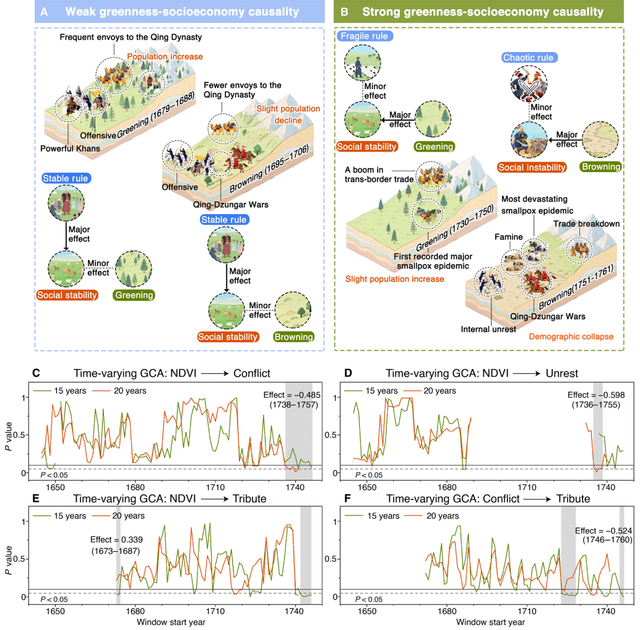
This historical case demonstrates that the relationship between steppe productivity and social stability was far from linear. During periods of stable political leadership and strong military power, the Dzungar Khanate was able to obtain resources through external trade and military expansion, alleviating the pressures caused by declining steppe productivity. However, once political rule became unstable and social buffering mechanisms failed, steppe degradation interacted with famine, internal unrest, trade disruption, and the smallpox epidemic, eventually developing into a systemic crisis.
Against the backdrop of present-day global warming, increasingly frequent extreme droughts, and rising risks of cross-border epidemics, the findings suggest that steppe regions should strengthen support for pastoral livelihoods, enhance social resilience, and improve epidemic monitoring so that cascading crises can be contained before multiple risks interact and amplify one another.
The corresponding author of the paper is Researcher Fang Keyan, and the first author is doctoral student Tang Wanru of Fujian Normal University. Fujian Normal University is the first affiliation and the institution of the corresponding author. Other co-authors include Mei Zepeng, Lin Shuheng, and Zhou Feifei from Fujian Normal University; Professor Hans W. Linderholm from the University of Gothenburg in Sweden; Professor Étienne Boucher from the Université du Québec à Montréal in Canada; Associate Professor Li Jinbao from the University of Hong Kong; Researcher J. Julio Camarero from the Pyrenean Ecology Institute in Spain; Professor Heikki Seppä from the University of Helsinki in Finland; and Academician Chen Fahu from the Institute of Tibetan Plateau Research, Chinese Academy of Sciences.
The study was jointly supported by the National Natural Science Foundation of China through the Tibetan Plateau Earth System Excellence Research Group Project (42588201), the National Science Fund for Distinguished Young Scholars (42425101), and a project of the Fujian Institute for Cross-Strait Integrated Development (LARH24JBO7), among other funding programs.
Paper link: https://www.science.org/doi/10.1126/sciadv.aee4285