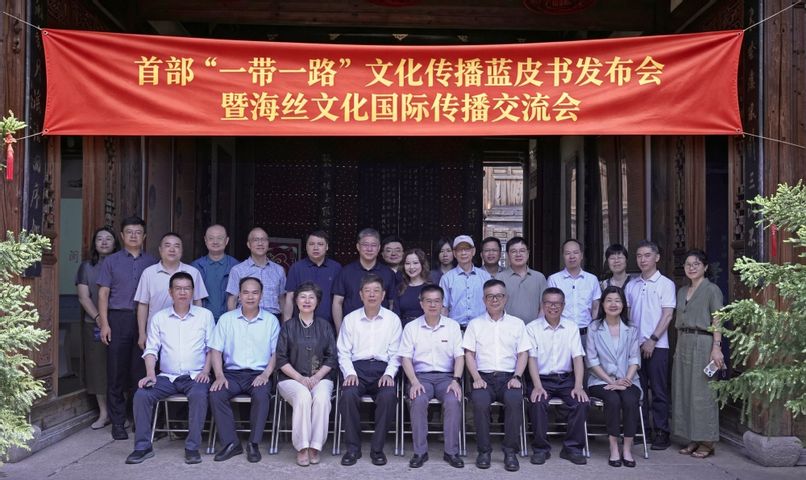
The event was held in Fuzhou on August 12. It was hosted by the Belt and Road Cultural Communication Research Base of the China Federation of Radio and Television Associations (CFRTA) and Fujian Media Group (FMG), and co-organized by the Fujian Television Artists Association, Fujian International Communication Center (FJICC), and the School of Communication at Fujian Normal University (FNU).
Tong Gang, Vice President of CFRTA; Gong Gaojian, second-level inspector of the Publicity Department of the CPC Fujian Provincial Committee; Ling Qidan, Party Secretary of FNU; and Zeng Xianghui, Deputy Director of the Culture, History and Learning Committee of the CPPCC Fujian Provincial Committee and Chairman of the Fujian Television Artists Association, attended and delivered speeches. Experts, scholars, and faculty and student representatives from the Communication University of China (CUC), the Belt and Road Research Center of the Chinese Academy of Social Sciences (CASS), the Bureau of Institutional Services of the National Radio and Television Administration (NRTA), the CFRTA’s Belt and Road Cultural Communication Research Base, and the School of Communication at FNU also attended.
Tong Gang noted that as Belt and Road cooperation entered its second golden decade, academia and industry urgently needed a theoretical work that could systematically review past experience, accurately assess the current situation, and offer forward-looking guidance. He said the Annual Report on Development of Belt and Road Cultural Communication (2025–2026)—the Blue Book—met this national strategic need and stood out for its systematic and authoritative approach.
Gong Gaojian remarked that Fujian, as the core area of the 21st-Century Maritime Silk Road, had built a range of international cultural platforms and produced outstanding documentary and cultural works in recent years. Released at the start of the 15th Five-Year Plan, the Report offered a useful reference for international communication. He called for using the Blue Book to deepen integration among academia, industry, universities, and research institutions, enhance cultural influence, and present a vivid image of Fujian.
Ling Qidan gave an overview of FNU and its recent educational achievements. He stressed that the Blue Book was a landmark outcome of FNU’s coordinated development with local government, industry, academia, and research, as well as a clear demonstration of the university’s service to China’s international cultural communication strategy. FNU would continue to strengthen its platforms, rely on solid academic research, and use inter-civilizational dialogue as a bond to produce more high-quality outcomes.
Zeng Xianghui pointed out that the Report offered a valuable theoretical reference for television arts professionals. He noted that Fujian television artists had long explored Maritime Silk Road themes and produced widely acclaimed works, and that the Blue Book was a systematic summary of these front-line experiences.
At the launch ceremony, Li Lan, chief editor of the Blue Book and professor at FNU’s School of Communication, interpreted the core content of the 2025–2026 volume. During the expert speech session, Ma Li, President of the China Animation Association; Zhang Yuqiang, professor at CUC; and Chen Jiawei, Vice Chairman of FMG, shared cutting-edge perspectives on international communication, exploring practical pathways for AI-empowered Chinese cultural communication and branded international outreach. The conference also held an unveiling ceremony for the compilation of the 2027 Blue Book.
The Annual Report on Development of Belt and Road Cultural Communication (2025–2026) is the first volume of China’s first Belt and Road cultural communication Blue Book. It brings together the research strength of 12 media and film/TV enterprises and 10 universities and research institutions nationwide, featuring contributions from dozens of renowned experts, scholars, and industry practitioners. It provides support for government decision-making, industry development, and academic research, and offers a multi-dimensional review of the prospects and challenges of Belt and Road cultural communication—reflecting the field’s shift from “one-way communication” to “two-way interaction” and from “cultural export” to “cultural symbiosis.” FNU served as chief editor and was deeply involved in compiling the book.